
The Roadmap We Expect
Most of us carry around an unspoken idea of how our lives will unfold. We build invisible roadmaps without even realizing it — the careers we’ll have, the family we’ll build, the places we’ll travel, the ordinary moments we assume will always be ours. We expect life to move forward in a mostly straight line. Detours are for other people.
So when small changes start happening in your body, you brush them off. A pain that lingers. Fatigue that doesn’t lift. Symptoms that don’t match each other or make sense.
You assume it’s stress, age, or a busy season. You expect it to pass.
But then it doesn’t.
The symptoms get louder. They interrupt your routines, your work, your mood. You start rearranging your days around what your body will allow. Appointments multiply. Tests stack up. Eventually, the questions have answers, and those answers have a name. A chronic illness — often invisible to everyone but you — now becomes part of your life story.
And just like that, the roadmap changes.
There is the life you planned. And then there is the life you have.
Living Between Two Realities
Living between those two can be exhausting.
Not only because of pain or fatigue, though those are real and relentless. The harder part is realizing that chronic illness quietly reshapes every corner of your life. It changes how you think about your future, how you move through an ordinary Tuesday.
Every decision becomes a small internal negotiation: Can I do this? Should I do this? If I do, what will tomorrow look like?
The Quiet Grief
There is grief in that — not the dramatic kind, but the quiet kind that slips into everyday moments. You grieve the ease you used to have, the future you thought was ahead of you, the freedom you assumed would always be yours, and the confidence you once carried without effort. You grieve the person you believed you were becoming.
But grief isn’t the whole story. It’s just one part of learning to live differently.
My world changed. It became smaller, quieter, different.
Some losses are harder to name, especially the ones involving relationships. Over the years, I’ve lost friendships. Sometimes they drifted away slowly — fewer check-ins, fewer invitations, fewer moments where I felt included. Maybe they thought they were helping. Maybe they assumed I couldn’t keep up. Maybe they just didn’t know what to say. I’ll probably never know.
Understanding the reasons doesn’t make it hurt less. Even when I couldn’t always say yes, staying connected still mattered.
And then there’s the part people rarely talk about:
Moods.
Chronic illness doesn’t just affect your body. It affects your emotional bandwidth. Pain, fatigue, and unpredictability can make you quieter, more withdrawn, or simply worn down. The people who love you may not always understand that your mood isn’t about them — it’s about the constant work your body is doing behind the scenes. That misunderstanding can create distance neither person intended.
The Invisible Parts People Miss
Another challenge of living with an invisible illness is that people respond to what they can see, not what they can’t.
They see whether you showed up — not the effort it took to get there. They see the good days, not the recovery days. They see the smile, not the pain behind it.
And because they can’t see the invisible parts, they often assume they aren’t there.
Life Doesn’t Pause
Meanwhile, life doesn’t pause. Bills still need to be paid. Work still needs to be done. The people you love still need you.
You still have responsibilities, and you still have dreams — even if they look different than the ones you started with.
I’ve lost count of how many times someone has told me to “stay positive” or reminded me that someone else has it worse. I know those words usually come from kindness.
But gratitude and grief can coexist. I can be thankful for what I still have while grieving what changed. One doesn’t erase the other.
Not Acceptance — Respect
For a long time, I thought the goal was acceptance. But acceptance felt too much like surrender — like agreeing to a life I didn’t choose.
Eventually, I found a different word.
Respect.
I don’t accept my illness. I respect it. I respect what it asks of me. I respect the limits it sets, even when I don’t like them. I respect the days when my body says “not today,” And I respect the days when it gives me a little more room to move, to try, to hope.
Respect allows space for frustration and possibility at the same time. It lets me honor what my mind and body can do without pretending it’s easy. It lets me build a life that still has joy, connection, purpose, and hope — even if it looks different than the one I planned.
Respect isn’t surrender. Respect is strength. And for many of us living with chronic or invisible illness, it’s the path forward.
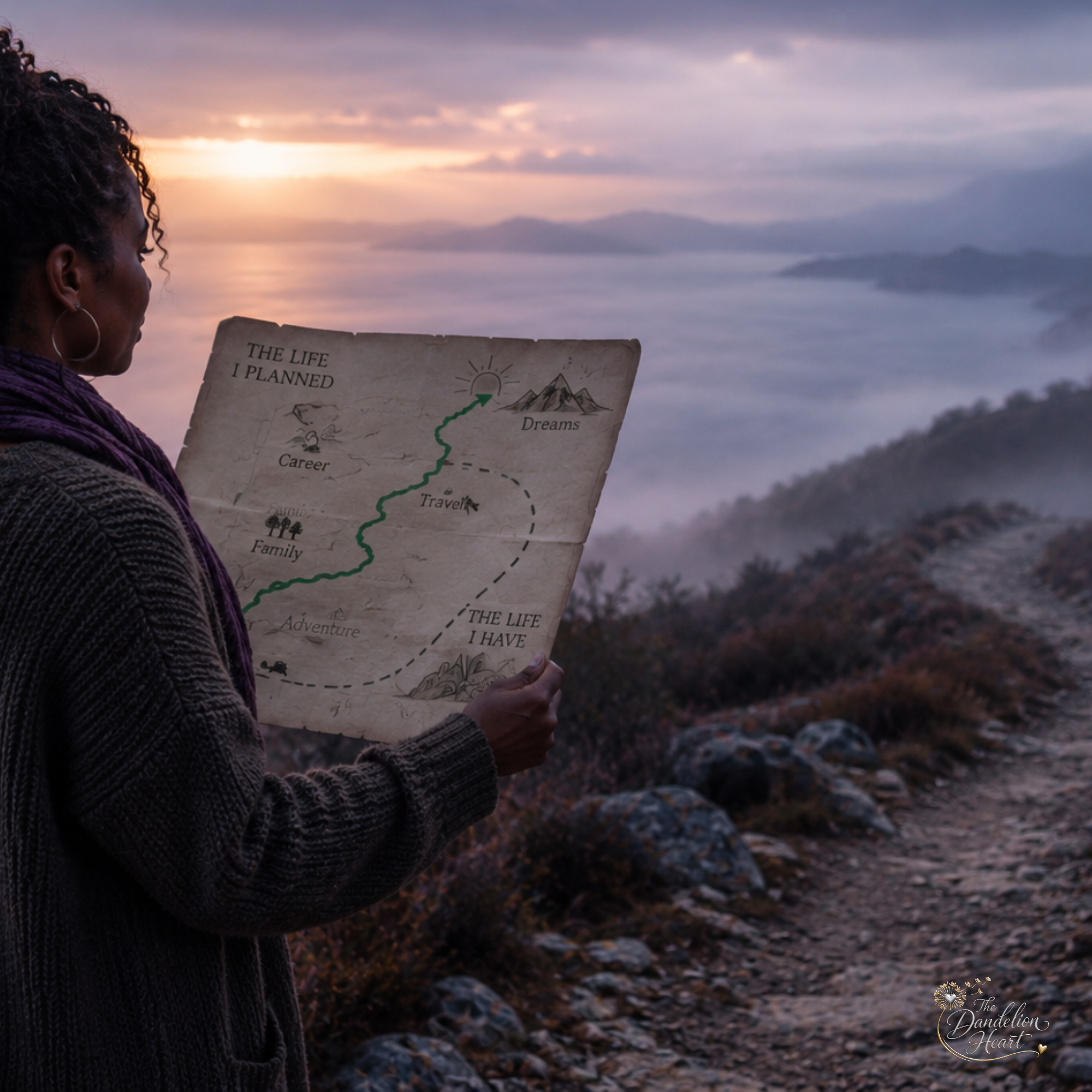
Woman standing on a rocky road holding a map, symbolizing navigating life with chronic illness.